


What Would You Do If You Arrived in Venice Just Before the Great Plague of 1575?
Updated: Aug 26
Edward de Vere’s Extraordinary Escape from the Great Plague in Renaissance Venice
Imagine it is May in the year of our Lord, 1575, and that you are a 25-year-old Englishman traveling for the first time to Venice, the richest maritime trading city in Europe. Hidden inside your doublet are letters from her Majesty, Queen Elizabeth I of England, ordering foreign princes and dukes to receive you as though they were receiving the Queen herself. Hidden inside your head is another purpose, a mission for her Majesty’s government.

At first sight, your breath catches. La Serenissima appears to float on the horizon. The sun blisters the dark waves, turning their tips rose and gold. Row upon row of grand palazzi admire their own reflections, broken into a thousand ripples, in the lagoon. The wind smells of fish, garbage and spices you can’t name.
As your craft draws nearer il Molo, the curt Venetian dialect, shouted between boats and shore, peppers the air. You imagine the hours you can spend exploring the books printed and bound in one of the largest publishing communities in the world.
The greatest adventure of your life is about to begin, and no one knows you are here.
Within weeks, infected by a deadly disease, this city will trap you in an island prison almost impossible to escape.
⚜️The Road to Venice Began with Perilous Politics in France
You are Edward de Vere, 17th Earl of Oxford, and your journey to Venice began as Queen Elizabeth I’s representative at the wedding and coronation of Henri III of France, the third of Catherine de Medici’s sons to take the French throne.
In the six weeks you spent at the French court in Paris and Reims, you favorably impressed the very family that had orchestrated the St. Bartholomew’s Day Massacre, carefully choosing every word, every joke, every gesture. French-English diplomacy was still raw. No one trusted anyone else.
Three years before, at the wedding of Henri’s sister, your royal hosts had proved that they were not above murdering Protestant noblemen like you. The Seine had run red with the blood of 10,000 wedding guests, all Protestants.
Read more about The St. Bartholomew’s Day Massacre and its effect on Elizabethan England here: The St. Bartholomew's Day Massacre: How an Intercepted Letter Exposed the Cover-up of the Slaughter and Reshaped Elizabeth's England.
Your mission in France had been designed as a test of your abilities. Your father-in-law, William Cecil, Lord Burghley, the Queen’s most trusted advisor, had spies who reported to him everything you did and every word you spoke.
Identifying them hadn’t been difficult. Fumbling William Lewin, attached to your traveling party at the last moment, could not have been more obvious. The English ambassador, Sir Valentine Dale, and his pretentious, loud wife who brayed her advice on your marital duties to the amusement of half the French court, reported everything to your father-in-law.
She imagined she knew everything about you and your marriage. She knew nothing.
(If you’d like to know what the English ambassador’s wife didn’t know about Edward de Vere’s marriage, that Elizabethan Secret is tucked in here: Abortion and the Secret Language of Elizabethan Women's Medicine).
You played the role necessary to pass the test and keep traveling. Ever the charming young English poet and playwright, you had made friends with the individual warring members of the treacherous Valois royal family. Your reward? Letters signed by Henri III himself that opened doors for you across France and Italy.
(Want to know why Queen Elizabeth sent her young noblemen abroad in the first place? Spoiler alert: It wasn’t an Elizabethan "Grand Tour": How Queen Elizabeth I Trained Young Noblemen as Diplomats, Soldiers and Spies
This post recounts a real individual’s extraordinary, historical journey across plague-stricken Renaissance Italy. Edward de Vere (1550–1604), 17th Earl of Oxford, was one of Queen Elizabeth I's leading noblemen. Whether remembered as a poet, patron of the arts, or the man behind the works attributed to William Shakespeare, he was one of the most widely traveled Englishmen of his generation.
Someone has been kind enough to write me: “This was both fascinating and beautifully written”. If you'd like more stories like this delivered to your inbox, you can join the adventure here:
🕵🏻♂️ Wintering in Strasbourg With Another of Burghley’s Spies
Even Johan Sturm, the renowned humanist scholar with whom you studied in Strasbourg to wait out the deep snows on the Alpine passes, was Burghley’s spy.
Again, you pretended not to know, patiently whittling down your traveling party to a handful of trusted companions, and duping Lewin and Sturm with indecision about your next destination. Italy? Greece? Constantinople? Germany? Who knew?
You did. And you kept it secret.
When you dumped Lewin and left Strasbourg in the middle of the night, you left no forwarding address.
🏔️ Crossing the Alps Into Italy
You sailed Lake Constance, the Inn River, and then waited for a traveling group with a guide to form to cross the Alps, partly riding, partly leading your stumbling horse over the Brenner Pass. You breathed in verdant valley air, sidestepped perilous drops, and arrived in Shakespeare’s “fruitful Lombardy”, decades before he wrote of it.
I am arriv’d for fruitful Lombardy,
The pleasant garden of great Italy.
- The Taming of the Shrew, I.ii

But Lombardy was neither fruitful nor safe for you, because it answers to the King of Spain, England’s most dangerous enemy. You are a well-known Protestant earl, carrying letters marking you as especially favored by the excommunicated Queen of England. You have had to use the Italian peninsula’s independent duchies and republics as your stepping stones amid vast hostile portions of Italy governed by Spain, and the Papal States.
You have been very careful where you set foot, where you reveal yourself as who you are, which of your letters you show. In some places your letters are a golden passport. In others, your death sentence.
While traveling by barge on the canals that crisscross Lombardy, through all of the cities in Shakespeare’s not-yet-written plays, Milan, Verona, Mantua, Padua, the plague had snapped at your heels. It had begun to feel like you had to outrun it.
(If you’d like to read more about Shakespeare and Italy, you might find these interesting:
And
From your barge, passing around Milan on its outer canals, red crosses damned the doors of those locked inside, whether rich or poor. Moans and cries leapt over the walls of the enormous lazaretto or quarantine hospital for plague victims built outside the city. Chilling sounds, worse smells. Bodies dumped in pits.
Here’s a little Elizabethan secret: The English word “quarantine” comes from the Italian quaranta giorni, in the Venetian dialect, quarantena, the forty days ships suspected of carrying plague had to wait offshore before passengers or cargo could land.
But that was Milan, and this is Venice.
☠️ The Plague Reaches Venice, June 1575
Or, it was, until the plague arrived in June on ships originating in Constantinople. The suffering and death had been conquering Italy, city by city. A commercial port like Venice had no chance to escape.
The alpine passes you had crossed months before are now closed. All of Italy is now a lazaretto, walled off from the rest of the continent by mountains of stone. You cannot return the way you came. No letters to or from home can pass. There is no way to call for help or advice.
Venice is rapidly locking down and quarantining. There is no English ambassador. Now, you’d even take Valentine Dale and his nosy wife if they could tell you what to do or where to go. On the other hand, Burghley’s other spies, surely here somewhere, cannot send word home about you.
It is time to survive on your own wits.
🚫 Venice Becomes an Island Prison (1575-1576)
You can’t now know that by the end of the 1575-76 pestilence, Venice will have lost over a quarter of its population and that more than 43,000 Venetians will die in a single year.
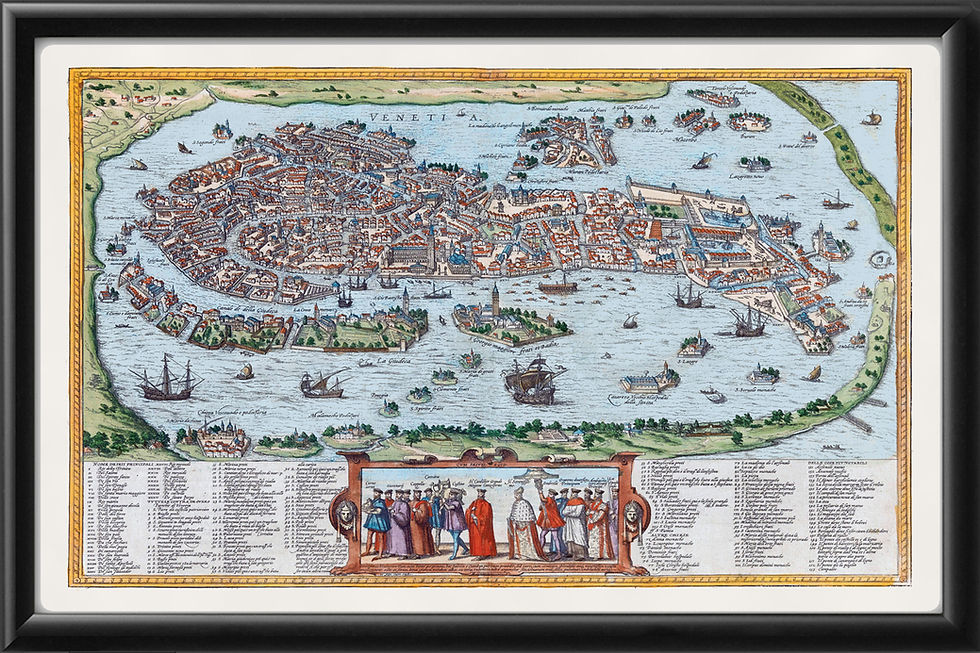
What you can observe is that incoming passengers and ships are quarantined. Carnivale is cancelled. Churches have closed their doors. The city has blockaded the Rialto bridge. Checkpoints encircle the lagoon. Incense burns everywhere. Smoke blackens the air as people try to purge it of infectious vapors.
For the first time since leaving England, you realize that if you die here, neither the Queen, nor your sister Mary will ever know what became of you. You will not even have a tomb here in Venice inscribed with your name, Edwardo de Vere, Compte d’Oxford, like the one in Santi Giovanni e Pauolo that holds the body of your scheming brother-in-law, Edward Windsor. Instead, your body will lie in a pit with thousands of others buried in unmarked graves in the islands’ meadows.
Like Milan, Venice has created lazzaretti on the outer lagoon’s outer islands. The Lazzaretto Vecchio can house only 10,000 plague victims. It is too small. Rocco Benedetti described it as “hell itself”, the air full of foul smells and groans and cries for help by the dying left to fend for themselves.
The Lazzaretto Nuovo, not much better, is warehousing incoming goods, sailors, passengers, and plague victim’s relatives who were not yet ill in a former monastery. When room to house the victims runs out, the Venetians are planning to raft thousands boats of all sizes together to create a floating lazzaretto.
⚖️ What Were Your Chances of Saving Your Own Life?
The obvious answer is to leave Venice as quickly as possible. Health permits, called bollettini or fedi di sanita, which existed centuries before Covid, must be obtained first. Can you stay healthy long enough to acquire one by some means?
Alone, abroad in the middle of a deadly pandemic, it is time to evaluate your resources. If you are Edward de Vere, 17th Earl of Oxford, you possess:
1. Excellent Italian, French, Latin and ancient Greek ➼ Therefore, the ability to communicate.
2. Elizabeth’s diplomatic letters identifying you as her cousin, and the Great Lord Chamberlain of England, and requiring that you be treated as herself. ➼ These could put you in prison, or worse, in the wrong hands.
3. Letters of recommendations from the King of France, Henri III ➼ Therefore, access to the King of France’s network.
4. Letters, secured in Paris from Giovanni Morosini, the Venetian ambassador to France, for travel in the entirety of the Venetian territories ➼ You can safely travel to the less populated territories controlled by Venice, spread across the north rim of the Adriatic Sea and down its eastern shore all the way to Butrint, Albania.
5. A marvel of a mind seeped in classic literature, including Virgil ➼ You have a map of the same area hidden in poetry in your head.
6. Money, or at least, credit ➼ Always useful.
⛵Where Could Edward de Vere, Earl of Oxford Go to Escape the Plague in 1575?
Trapped by the blocked Alpine passes to the north, by virulent plague to the west, and unable to flee south into the two thirds of the Italian peninsula ruled by the Kingdom of Naples and the Papal States, what options remained?
To sail east from Shakespeare’s Venice, along the sparsely populated Adriatic coast, an area called Illyria.
I think Edward de Vere, 17th Earl of Oxford took it.
If you travel here: Where Did Edward de Vere, Earl of Oxford Go When He Vanished from Plague-Stricken Venice?, you can follow him across the Adriatic into lands few Englishmen ever saw, but in which Shakespeare set quite a few of his plays.
Subscribe here to make sure you are along for the incredible journey east and south: Send Me the Secrets! A gift box of exclusive Elizabethan Secrets will be sent to you as a thank you!


