


Anne Cecil, Countess of Oxford: How Burghley House Shaped the Woman She Became
How growing up amid extraordinary wealth, parental ambition and surveillance shaped one of Elizabethan England’s quietest, and most underestimated, women.
Part 1 of a Series: Three Elizabethan Women, Three Houses, Three Days.
This summer, I visited three Tudor women’s family homes on three consecutive days with one question: What can landscape, architecture, and place tell us about the women who lived there? First, come with me to Burghley House to meet Anne Cecil de Vere, Countess of Oxford.

Anne Cecil de Vere, Countess of Oxford, (1556-1588) was not a woman you would notice at first.
Her entrance to a room would not trumpet “courageous Tudor heroine”. Short, plain, pious, and shy, Anne was the first surviving child of Queen Elizabeth I’s chief minister, William Cecil and his wife, Mildred Cooke Cecil, born before the Queen conferred the titles of Baron and Lady Burghley on them.
Anne gratified her father’s ambition when he married her at age fifteen to Edward de Vere, Earl of Oxford. At her death, of a fever at age thirty-one at Greenwich Palace during the Spanish Armada, she left three daughters. Her tomb in Westminster Abbey is grander than those of several kings and queens of England who lie there, including Elizabeth I’s.
But if history noticed Anne at all, it would characterize her as a mouse.
Of course, history hasn’t much noticed Anne Cecil, because Anne is the consummate Elizabethan secret.
I wondered what made her that way.
Examined closely, Anne’s life indicates a woman endlessly subject to direction from her strong-willed mother and aunts, and constantly torn between father, husband, Queen Elizabeth herself, and Robert Dudley, Earl of Leicester.
But later in her life, Anne did something that no one would have expected from looking at her: she put in writing the most closely guarded secret of the Elizabethan age.
Burghley House’s Influence on Anne Cecil
This summer, I visited Burghley House in Stamford, Lincolnshire. Anne and her parents traveled frequently among the three great houses they built and owned. Only Burghley House stands today.
I have studied Anne for years, and written a novel about her. I knew that she had grown up amid luxuries unmatchable by all but the wealthiest Elizabethan nobility. But until I stood in front of Burghley House, I had not considered how physically overwhelming a place it was, or how little privacy it offered.

What fascinated me is that Anne and Burghley House seem to be completely at odds. Her modesty versus its ostentation. Her introversion versus its spaciousness, built to host queen, court, armies of servants, and stables for the 300 oxen to cart all the luggage. Burghley House’s interior spaces are far from intimate. They would have soared over the head of a woman considered small by every contemporary measure. Her piety seemed too simple amid all this stone adorned with costly furniture.
Burghley House impresses and intimidates. It would have pressed Anne, not to become more extraverted and confident, but to shrink further from it, to become more introverted and unsure of herself.
🏰 Burghley House: Anne Cecil’s Gilded and Privileged World of Piety and Splendor
William Cecil commenced constructing Burghley House in 1555. He worked on it for over thirty-two years. Designing, constructing, decorating and maintaining three such homes certainly lends credence to his claim that he was “the poorest peer in England”. His enemies liked to remind him that his grandfather had kept an inn in nearby Stamford. Perhaps, for that reason, he chose this location for Burghley House. He passed it on to his elder son, Thomas, as the foundation of a dynasty that exists to this day.
If you’d like to learn more about Anne’s father, William Cecil, click here:
And,
Anne’s mother, Mildred Cecil, was more involved on the income side of the Cecils’ balance sheet: access to the ear of the Queen. Rents, royal preferments, and what we today would call “graft” was simply the price of doing business with William and Mildred Cecil.
If you’d like to meet Anne’s formidable mother and aunts, click here:
Burghley House appears surprisingly aloof, even lonely in the middle of its immense open lawn. The extensive gardens of Capability Brown’s design, and the far-off manmade lake and bridge that now keep it company came later than Anne’s time there. Its exterior glows golden thanks to honey-colored limestone. Each one of its seventy-six decorative chimneys and endless small finials and obelisks poke up above the roof like jewels on spikes in a field of crowns. Its gates are wrought with golden vines and tendrils.
Burghley studied Italian and French architecture to design and redesign the vast exterior and over one hundred interior rooms. He liked to claim that Burghley House was “his mother’s house.” There is a touching portrait of her at Burghley House, eyes cast downward. Nothing about the house fits gentle Jane Cecil any more than it fits Anne.
Enjoy meeting the women history left in the shadows?
If you enjoy discovering the real Elizabethan women whose lives, choices and secrets rarely make it into traditional history, join me for more investigations into The Secret Lives of Elizabethans, and I'll send each new journey directly to your inbox, along with a welcome gift box 🎁 of exclusive secrets.
Join the journey into Elizabethan history here:
“I can’t wait for the mini-series to come out.” - A subscriber
Burghley paused construction on Burghley House when he began Theobalds, another enormous Cecil mansion, much closer to London. There he entertained the Queen a dozen times. Her planned visit to Burghley House in 1566 was cancelled due to smallpox in the household, likely Anne’s. So despite rooms and beds named for Elizabeth I at Burghley House, she never set a slippered foot on the property.
🗝️ Inside Burghley House: The World that Surrounded Anne Cecil
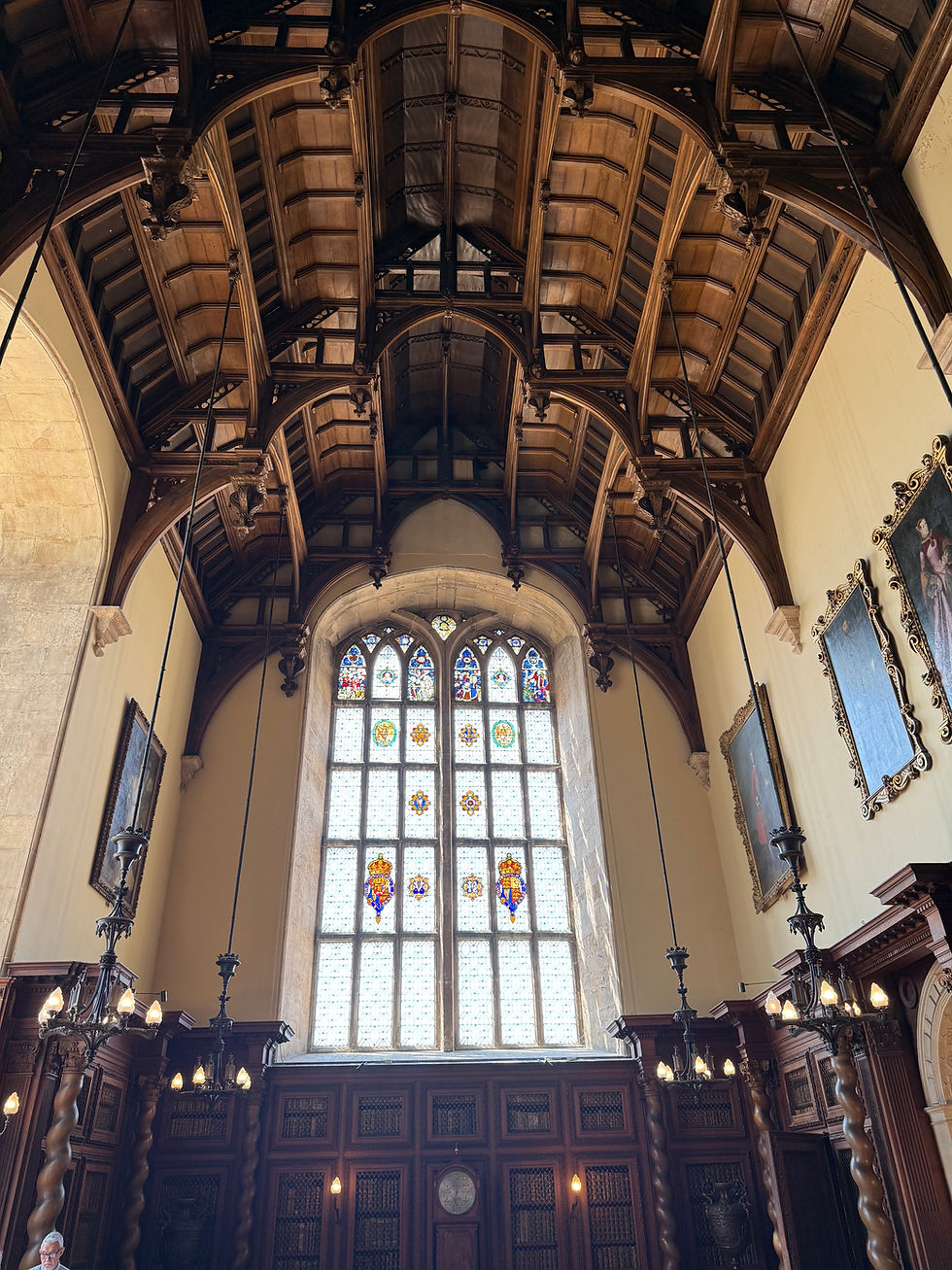
The exterior is prelude. The interior reveals the true extent of the Cecils’ wealth. Little of the Elizabethan interiors, and no Tudor furniture remains today. Anne would recognize only some family portraits, the kitchen, and the fireplace and soaring double-hammer beam ceiling of the Great Hall. Burghley’s descendants, who became Earls and Marquises, furnished the house as we see it today.
A visitor begins imagining the din of cooks and spit boys in the cavernous Tudor kitchen. Reaching the Tudor great hall requires passing through a string of state rooms and bedrooms in which every surface, wall, ceiling and floor is covered in intricate and remarkable decorative art.
Nothing in Burghley House is simple or understated. Every inch that can be adorned is adorned, from priceless furniture laden with rare collectors’ pieces, to over 800 dramatic Italian paintings that cover nearly every inch of the walls. On Antonio Verrio’s (1636-1707) crowded tromp l’oeil ceilings, swirling figures and fabric spill towards the priceless rugs and tumble down a stairway depicting the gaping mouth of a literal hell cat tormenting the souls of the damned.
The eye cannot absorb every detail. It is too much.
👁️ A House of Eyes and Spies
I had not anticipated how many people were constantly around Anne. Her immediate family was small, but there were always state and government visitors come for her father, with whom she might be required to dine, his multiple secretaries, hundreds of servants and her his army of spies. In a house like this, even with no visitors, you were never alone because you lived under the same roof with the individuals required to maintain the house, its grounds, kitchens, stables, offices, hospitality, and fires.
Any dish she wished could be prepared for and brought to her. She never did her own laundry or washed a dish. If she looked up from her embroidery and out a window, she saw gardeners manicuring her father’s famous gardens. If she crossed a landing or descended a staircase, someone would know she had left her chambers. If she stared too long out a window, someone would tell her father. If she vomited in her chamber pot overnight, her mother would know by morning. Nothing Anne did was private in this house.

If Anne knew the satisfaction of her needlework or of mixing medicinal elixirs in the stillroom, those might be semi-private accomplishments of her own choosing. Otherwise, her life here was scripted for her. She played a part chosen for her, enclosed within a world created by a man who changed their family surname to “Cecil” from “Cyssell”, and claimed descent from the Roman “Caecilii”. The “Roman” staircase at Burghley House, for display of ancestral arms and badges, pays homage to that fantasy.
Was Anne expected to believe the myth, I wondered as I mounted the “Roman” stair. Or was she embarrassed by it?
It took two tries to marry Anne to Edward de Vere. He simply didn’t attend their first wedding. It may be that only a royal command and a promise to save the life of his uncle, the Duke of Norfolk, brought him to Anne’s side at the altar the second time. Raised from age twelve by Burghley due to his father’s death, it is likely that de Vere knew Burghley House and that by marrying Anne, he would be submitting himself to constant surveillance as well.
You can discover a secret buried in Anne’s and Edward de Vere’s marriage here:
🙅🏼♀️ How Burghley House Formed Anne Cecil
How does a woman raised under constant observation inside a house proudly proclaiming wealth and ambition understand the world?
Look at the woman. Now look at the house.
She burrows deep inside the only private space she owns. Herself.
I came away from Burghley House even more convinced that Anne Cecil crept along these hallways and stood in the corners of these many rooms trying not to be noticed. Like the house itself, Anne appears isolated from the outside, but she is crammed with intricacies within.
When Anne chose to state what everyone suspected, but no one would say, it was startling, and more credible for having come from her. Because, if they saw her at all, no one would expect it.
If you want to learn more about Anne Cecil’s life, click here for an illustrated lecture:
Enjoyed meeting Anne? Join me for more hidden lives and Elizabethan secrets.
Subscribe 🦢 Send me the Secrets!


